


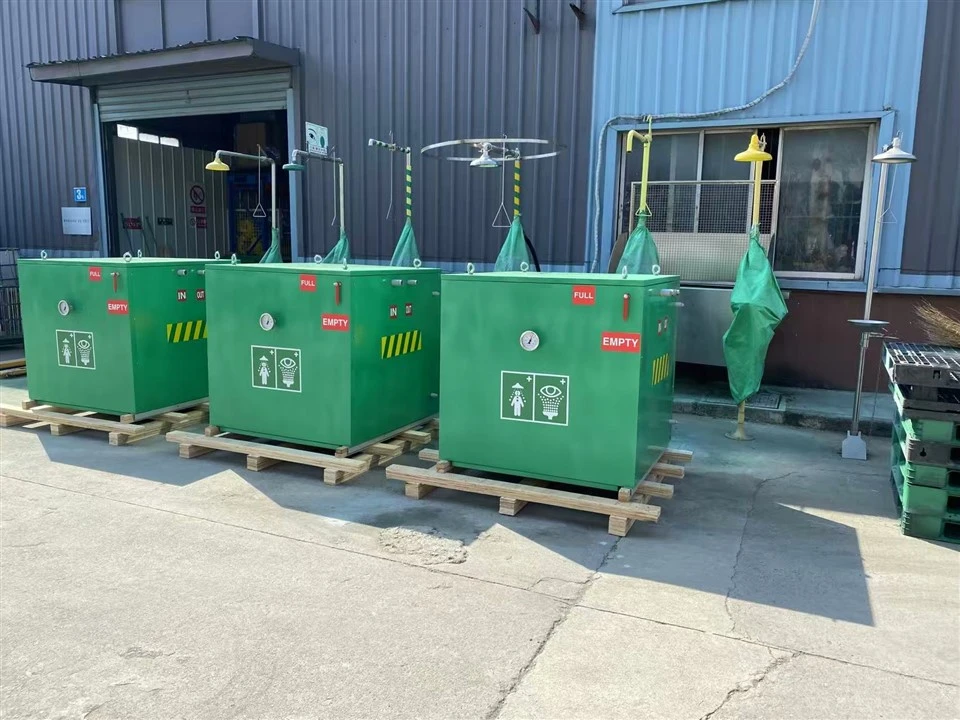
Self-Contained Pressurized Emergency Shower Unit
The Self-Contained Pressurized Emergency Shower Unit provides stored water for emergency body and eye flushing in industrial locations without a suitable permanent water connection. The system combines a pressurized storage tank, emergency shower, and eyewash assembly, with pressure monitoring and protection components. Designed with reference to ANSI/ISEA Z358.1 performance principles, tank capacity, flow rate, operating pressure, and flushing duration can be specified according to site conditions and applicable safety requirements.
Key Product Advantages
Independent Water Supply: The integrated tank provides a dedicated water supply for emergency flushing in remote work areas, industrial facilities, and locations where permanent plumbing is unavailable.
Combined Shower and Eyewash: The integrated arrangement provides body and eye flushing functions at one designated station. Flow rates and simultaneous operating capability are designed to match intended applications and safety standards.
Pressure Monitoring: A pressure gauge supports routine operating checks, while the pressure relief valve provides pressure protection according to its specified setting.
Project-Specific Configuration: Tank materials, equipment layout, connections, and selected accessories can be reviewed against installation conditions and project specifications before production.
Technical Specifications
|
Parameter |
Specification |
|
Product Type |
Self-Contained Pressurized Emergency Shower Unit |
|
Tank Capacity |
140 L |
|
Tank Material |
304 Stainless Steel |
|
Working Pressure |
2.1–6.2 bar |
|
Shower Flow Rate |
≥ 76 L/min |
|
Eyewash Flow Rate |
≥ 11.5 L/min |
|
Pressure Gauge |
1 Unit |
|
Pressure Relief Valve |
1 Unit |
|
Activation Method |
Push Plate (Stay-open valve design) |
|
Overall Dimensions |
800 × 600 × 2100 mm |
|
Empty Weight |
95 kg |
Applications
Chemical Processing: Provides an emergency flushing point near designated chemical handling areas, subject to the site risk assessment and applicable safety requirements.
Industrial Manufacturing: Supports emergency response arrangements in production areas, maintenance zones, and designated industrial workspaces.
Laboratories: Provides an independent flushing water source for laboratory areas where the selected configuration meets site requirements.
Remote Facilities: Supports emergency response arrangements at isolated work locations without a suitable permanent water connection.
How to Select the Right Unit
Water Capacity & Duration: Check nominal tank capacity and usable water volume against the standard 15-minute emergency flushing duration (per ANSI/ISEA Z358.1). Confirm that the available supply meets the specified flow demand.
Flow and Pressure: Verify shower and eyewash flow rates, operating pressure, and pressure relief settings. Where simultaneous operation is required, confirm combined flow performance and available duration.
Installation Space: Review overall dimensions, floor loading, filling access, drainage, and maintenance clearance before confirming the installation location.
Operating Conditions: Identify ambient temperature, water quality, corrosion exposure, and any requirements for insulation or temperature control.
Configuration and Customization
Tank Materials: Material options can be reviewed according to water quality, cleaning procedures, and the surrounding environment.
Component Layout: Shower and eyewash positions, valves, gauges, and pipework can be assessed for accessibility and maintenance.
Dimensions and Connections: Installation dimensions, filling arrangements, and required interfaces should be confirmed before production.
Environmental Options: Insulation, temperature control, and protective enclosures can be evaluated where suitable for the application.
Materials and System Components
Storage Tank: The reference configuration uses 304 stainless steel. Material suitability should be assessed against water quality, cleaning requirements, and environmental exposure.
Pressure Components: The gauge, relief valve, fittings, and associated components should match the specified operating limits and system design.
Shower and Eyewash Assembly: Spray heads, operating valves, and connecting pipework are engineered to meet required flow specifications and allow routine inspection.
Installation and Maintenance
Installation Preparation: Prepare a suitable supporting surface and confirm equipment clearance, filling access, drainage, and maintenance space before installation.
Routine Inspection: Check the tank, water level, pressure, valves, spray outlets, and protective components according to the operating instructions and site procedures.
Water Management: Follow the specified procedures for water replacement, tank cleaning, functional testing, and maintenance records. Confirm inspection frequency and flushing requirements before commissioning.
Quality and Technical Documentation
Product Specifications: Provide the applicable datasheet, dimensional drawing, material information, and component specifications.
Inspection Records: Inspection and test records can be supplied where applicable to the selected configuration.
Compliance Documents: Designed to meet ANSI/ISEA Z358.1 performance criteria. Required conformity documents should be confirmed for the destination market and intended application.
Frequently Asked Questions
Q: Does the unit require a permanent water connection?
A: A permanent connection is not required for emergency operation when the unit is correctly filled and pressurized. Filling and maintenance arrangements are still necessary.
Q: How long can the stored water support flushing?
A: Duration depends on usable water volume and actual flow demand. For standard compliance, please confirm the required tank capacity matching your specific flow configuration.
Q: Can the unit be customized?
A: Available options may include tank materials, dimensions, component layout, and connections, subject to technical feasibility.
Q: Can the unit be installed outdoors?
A: Outdoor suitability depends on ambient temperature, weather exposure, water temperature requirements, and the selected protective measures.
Q: What information is needed for a quotation?
A: Provide the required capacity, shower and eyewash configuration, operating environment, installation dimensions, destination market, applicable standards, and customization requirements.
Hot Tags: self-contained pressurized emergency shower unit, China self-contained pressurized emergency shower unit manufacturers, suppliers, factory, Heated Freeze-Protected Emergency Shower
Previous
No InformationYou Might Also Like


Send Inquiry